

What Is Secondary Supply?
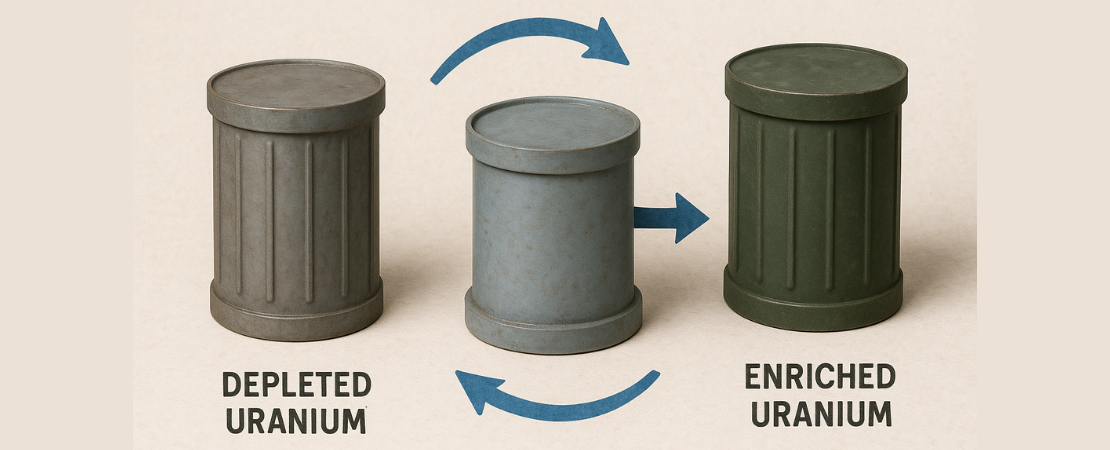
“Secondary supply” refers to any uranium that enters the market from sources other than primary production. Historically, one of the largest sources of secondary supply has been the re-enrichment of tails (depleted uranium).
The Role of Enrichers and Tails
When enrichers such as Orano or Urenco enrich natural uranium, they produce EUP (enriched uranium product) per customer specifications. However, they also end up with and retain depleted uranium, known as “tails”—natural UF6 in which the concentration of U235 is less than 0.7%.
All enrichers have a point at which it’s no longer economical to continue separating U235 from U238.
Russia’s Role in Re-Enrichment
Historically, Orano and Urenco contracted with Russia to further strip down the tails left over from their enrichment operations. They would deliver depleted uranium to Russia, where Russian enrichment plants would extract even more U235.
Russia would then return either natural UF6 or EUP, depending on the contract. However, Russia kept the “secondary tails”—the further depleted UF6 resulting from the re-enrichment process—and re-enriched those as well. They could do this because of:
– Exceptionally low costs of enrichment
– Highly efficient enrichment processes
Competitive Imbalance
Orano and Urenco had long argued they were unfairly excluded from the Russian domestic enrichment market. These re-enrichment contracts were a tacit acknowledgment that Russia’s enrichment costs were substantially lower, which was the main reason Russian utilities wouldn’t consider buying services from Western suppliers.
Impact on the Market
As a result of these contracts, the market received secondary supply from two sources:
1. Re-enrichment of Urenco and Orano tails
2. Re-enrichment of secondary tails left over from the initial re-enrichment
Fallout from the War in Ukraine
Once Russia invaded Ukraine, Urenco and Orano terminated their contracts with Tenex, the Russian enrichment firm. This action cut off both sources of secondary supply.
Bottom Line
The loss of these secondary supplies is yet another reason why the total amount of uranium available in the world market today is lower than it was before the war in Ukraine.